OUR BREWERY HERITAGE

Brewing in Westerham dates back to the early 1600’s. In 1841 Robert Day established The Black Eagle Brewery in Westerham to brew pale bitter ales while he continued to brew Porters in Bermondsey, using London’s softer water.
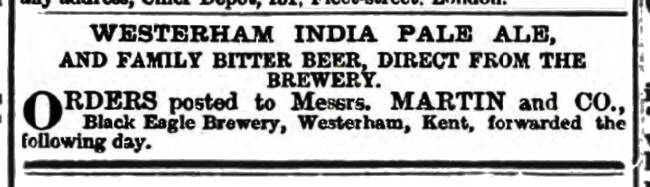
Sussex Agricultural Express – 6 November 1877
In 1862 Ben Bushell joined the partnership and for the next 40 years he was to drive the growth in the business. Such was the success of The Black Eagle Brewery that in 1881 a branch line from Sevenoaks to Westerham was constructed to carry beer to and from London. By the turn of the century the brewery was the largest employer in Westerham.
MODIFICATION XXX DEPTH CHARGES
The Second World War could not put a stop to one of Kent’s finest breweries, and Westerham’s ales were popular with young airmen stationed at nearby RAF Biggin Hill. Indeed, following the D-Day landings, Westerham Ales were exported to troops in Normandy inside the auxiliary fuel tanks of Spitfires! They were dubbed “Modification XXX Depth Charges” to get them officially approved for flights.
Edward (Ted) Turner Describing working at Brittain’s Engineering in Peckham:
“We were also making ‘jettison’, auxiliary fuel tanks for fighter planes to carry extra fuel to enable them to fly further into Europe and still be able to get back home. Once refueling facilities were established over there, the Westerham Brewery used to fill those auxiliary non-returnable petrol tanks with Westerham Ales for our troops in Europe. Black Eagle lorries delivered it in barrels to Biggin Hill where the auxiliary dual purpose tanks were filled with Bitter on one side and Mild on the other. We made them of 16 gauge metal with baffles for safe landing, the RAF’s version of the brewer’s dray.” Westerham and Crockham Hill in the War
In his book “Dancing in the Skies”, Tony Jonsson, the only Icelander pilot in the RAF, recalled beer runs while he was flying with 65 Squadron. Every week a pilot was sent back to the UK to fill some cleaned-up drop tanks with beer and return to the squadron. Jonsson hated the beer runs as every man on the squadron would be watching you upon arrival. Anyone who made a rough landing and dropped the tanks would be the most hated man on the squadron for an entire week. (Gaëtan Marie)
The famous Spitfire test pilot Jeffrey Quill stated “After D-Day in 1944, there was a problem about getting beer over to the Normandy airfields. Henty and Constable (the Sussex brewers) were happy to make the stuff available at the 83 Group Support Unit at Ford near Littlehampton. For some inexplicable reason, however, beer had a low priority rating on the available freight aircraft. So we adapted Spitfire bomb racks so that an 18-gallon (82-litre) barrel could be carried under each wing of the Spitfires which were being ferried across from Ford to Normandy on a daily basis. We were, in fact, a little concerned about the strength situation of the barrels, and on application to Henty and Constables for basic stressing data we were astonished to find that the eventuality of being flown on the bomb racks of a Spitfire was a case which had not been taken into consideration in the design of the barrels. However, flight tests proved them to be up to the job. This installation, incidentally, was known as Mod XXX Depth charge.” Source: Air International, September 1976; Aviation News, 8-21 April 1994


Cask of Westerham Bitter sent to France
The caption reads “This cask containing “Westerham” Bitter was flown to France, June 6th 1944 by the Royal Air Force”


BRITISH BULLDOG
Renowned for producing fine pale ales for nearly 300 years, the town of Westerham is where Sir Winston Churchill made his family home. For over forty years Sir Winston enjoyed his country retreat and said “a day away from Chartwell is a day wasted”.
Churchill’s indomitable fighting spirit carried Great Britain through the darkest days of World War II and earned him the nickname ‘British Bulldog’ by Josef Stalin.
British Bulldog is a full bodied Best Bitter in the Kentish Ale style, packed full of Kent hops to give this ale its distinctive aroma and satisfying flavour. Recultured yeast from the original Black Eagle brewery recreates the flavours of Westerham Ales as they were enjoyed by Sir Winston Churchill.
Beer from the Garden of England

TITSEY Heritage
The Titsey Estate, near Oxted, is one of the largest surviving historic estates in Surrey and the families who have lived there have been among the county’s most powerful residents.
To give you a quick glimpse of the history, the Titsey Estate was acquired in 1534 by Sir John Gresham who was a member of one of the most prominent merchant dynasties in Tudor England and was later named Lord Mayor of London. You’ll still see signs of his family symbol, the Gresham Grasshopper, in prominent locations around London today, including above the Royal Exchange in the City of London which was founded by his nephew Sir Thomas Gresham.
William Leveson-Gower married the heiress Katherine-Maria Gresham in 1804 and the family continued to live at Titsey Place until 1992, when the last of four unmarried brothers, Thomas Leveson-Gower died.The Estate then passed to his ward David Innes, who became the Governor of the Titsey Foundation, which is responsible for the house and surrounding parkland. The Innes family have links to the brewing trade both through John Topham-Richardson, one of the major nineteenth century Southwark hop merchants as well as the Reids of Watney, Combe Reid & Co.
Majority owned by the Titsey Estate Company, Titsey Brewing Co takes inspiration from this rich heritage to produce our delicious beers – and we’re found only a short bike ride or countryside walk away from the historic house.